Master R Programming in 2026: 5 Great Ways to Start Your Data Science Journey

Master R Programming in 2026: 5 Great Ways to Start Your Data Science Journey

Master R Programming in 2026: 5 Great Ways to Start Your Data Science Journey

• 8 min read

The data landscape has evolved rapidly, but in 2026, R programming remains the gold standard for statistical analysis, bioinformatics, and high-level data visualization. Whether you are a student, a researcher, or a career-changer, the tools available today make learning R faster and more intuitive than ever before.

If you’re wondering how to break into data science this year, here are the five best ways to learn R programming in 2026.

1. Leverage Visual Learning with R-Galleon YouTube Tutorials

R-Galleon YouTube Channel

For many aspiring data scientists, the biggest hurdle in coding is mastering the syntax. Visual learners can bypass this frustration by following high-quality video walkthroughs that demonstrate R programming concepts in real-time.

R-Galleon YouTube Channel screenshot showing R programming tutorial

The R-Galleon YouTube Channel is a great destination for 2026 learners. By watching real-time coding sessions, you can see exactly how scripts are built, debugged, and executed. YouTube is an excellent free resource to get comfortable with the RStudio environment and the Tidyverse ecosystem before diving into deeper projects.

Why it works: Visual demonstrations help you understand not just what to code, but why each line matters. You’ll see common errors and learn troubleshooting techniques in context.

Watch R-Galleon Tutorials

2. Learn on the Go with the Chat-R Mobile App

Chat-R Mobile Application

In 2026, you don’t need to be tethered to a desk to master data science. Mobile-first learning is a game changer for busy professionals who want to maximize their learning time.

Chat-R mobile app interface on iPhone showing interactive R programming exercises

The Chat-R App provides an interactive, test-based environment right on your iPhone. It allows you to practice R syntax and solve coding challenges during your commute or coffee break. This “micro-learning” approach ensures that you stay consistent, which is the key to mastering any programming language.

Key features: Interactive coding exercises, AI-powered assistance for debugging, bite-sized lessons perfect for 10-15 minute sessions, and progress tracking to keep you motivated.

Download Chat-R for iPhone

3. Build a Strong Foundation with “Introduction to R for Non-Programmers”

Introduction to R for Non-Programmers by William Franz Lamberti

If you have zero background in computer science, jumping straight into advanced documentation can be overwhelming. You need a guide that speaks your language and builds your confidence from the ground up.

Introduction to R for Non-Programmers book cover by William Franz Lamberti

The book “Introduction to R for Non-Programmers” by William Franz Lamberti is a must-have resource for beginners. It focuses on logic and data handling without the “gatekeeping” jargon often found in technical manuals. It’s the perfect starting point for students, social scientists, and business analysts who want to let R do the heavy lifting for their data.

What makes it special: Written specifically for non-technical audiences, real-world examples from multiple industries, step-by-step explanations without assuming prior knowledge, and practical exercises you can apply immediately to your work.

Get the Book on Amazon

4. Use Specialized AI Mentorship via R-Stats Professor

R-Stats Professor AI Tutor

The biggest trend in 2026 is the shift from generic search engines to specialized AI tutors. While general AI can sometimes hallucinate code or provide incorrect statistical guidance, a tool dedicated specifically to R statistics is invaluable.

R-Stats Professor AI interface showing statistical analysis assistance

R-Stats Professor acts as a specialized digital mentor. It helps you navigate complex statistical tests and R packages with precision. Instead of spending hours scrolling through Stack Overflow, you can use this platform to get tailored explanations and error corrections designed specifically for the R environment.

Benefits over generic AI: Specialized knowledge of R packages like dplyr, ggplot2, and tidyr; accurate statistical methodology guidance; context-aware debugging that understands your specific workflow; and recommendations for best practices in reproducible research.

Try R-Stats Professor

5. Implement Project-Based Learning

The final—and most important—step is to put your tools to work. The most effective way to learn R programming is by building real projects that solve actual problems. Here’s a systematic approach that combines all the resources mentioned above:

  • Step A: Watch a tutorial on R-Galleon. Choose a topic relevant to your field (data visualization, statistical modeling, data cleaning, etc.) and follow along with a video tutorial.
  • Step B: Test the logic on your phone using Chat-R. During breaks or commute time, practice the concepts you learned by solving related exercises on the mobile app.
  • Step C: Reference your textbook for the “why” behind the code. When you encounter confusing concepts, refer back to the book to understand the underlying statistical principles and programming logic.
  • Step D: Refine your project with R-Stats Professor. Use the AI tutor to debug errors, optimize your code, and ensure you’re following best practices for statistical analysis.

Project ideas for beginners: Analyze a dataset from your workplace or field of study, create visualizations of public health or economic data, build a dashboard to track personal metrics, automate a repetitive data task, or replicate findings from a published research paper.

By the end of 2026, you won’t just “know” R—you will be using it to solve real-world problems and building a portfolio that demonstrates your data science capabilities to potential employers or collaborators.

Start Your R Programming Journey Today

Learning R in 2026 is no longer about memorizing dry commands; it’s about utilizing a smart ecosystem of video tutorials, mobile apps, foundational literature, and AI assistance.

Start today by picking one of these resources and writing your first line of code. The data science career you’ve been dreaming of is just a few R commands away!

Start Learning R Free

Frequently Asked Questions About Learning R in 2026

What is the best way to learn R programming in 2026?

The best way to learn R in 2026 combines multiple approaches: visual learning through YouTube tutorials (R-Galleon), mobile practice with the Chat-R app, foundational reading with “Introduction to R for Non-Programmers,” AI mentorship via R-Stats Professor, and project-based learning to build a real portfolio. This multi-modal approach ensures you understand both the theory and practical application of R programming.

Can I learn R programming on my phone?

Yes, the Chat-R mobile app for iPhone provides an AI-enhanced environment where you can practice R syntax, ask questions, and solve coding challenges on the go. This makes it perfect for micro-learning during commutes or breaks, helping you stay consistent with your learning journey.

Is R programming still relevant in 2026?

Absolutely. R programming remains the gold standard for statistical analysis, bioinformatics, and high-level data visualization in 2026. Modern tools and AI-assisted learning platforms have made R more accessible than ever, while its capabilities for advanced analytics continue to make it indispensable in research, healthcare, and data science fields.

How long does it take to learn R programming?

With consistent practice using modern learning tools, you can gain basic proficiency in R within 2-3 months. Most learners can start working on real projects within 4-6 weeks of dedicated study. The key is consistency—using resources like Chat-R for daily practice and following structured tutorials can significantly accelerate your learning curve.

Do I need a programming background to learn R?

No programming background is required. Resources like “Introduction to R for Non-Programmers” by William Franz Lamberti are specifically designed for people without coding experience. R is actually an excellent first programming language because of its focus on data manipulation and visualization, which provides immediate, tangible results.

How to Download R in 2026 the Age of Generative AI

The days of scouring dense documentation and outdated forum threads just to set up your environment are over. In 2026, the barrier between “I want to learn data science” and actually running your first script has been demolished by AI.

If you are looking to download R, you no longer have to navigate the Comprehensive R Archive Network (CRAN) alone. Using an AI tutor like the R Statistics Professor makes the installation process conversational, error-proof, and tailored to your specific operating system.


Why Use AI to Install R?

While the core process of downloading R hasn’t changed drastically, the support around it has. Traditional installers don’t tell you why your path variables are messed up or which version of RStudio matches your new R 4.5.2 installation.

The R Statistics Professor acts as a bridge, ensuring that by the time you finish the download, you actually understand what you just installed.


How to Set Up R Using the R Statistics Professor

Follow these four steps to get your statistical environment running in minutes.

1. Login to the Portal

First, head over to the official tool page: https://r-stats-professor.rgalleon.com

You can log in securely using your Google account. You can use this tool to help you install specific packages like tidyverse or ggplot2.

2. Ask the Professor for Download Guidance

Once you’ve started a new chat, type the following query into the box:

“How to download R on my computer?”

The AI will immediately detect your context and provide a curated list of links and instructions for Windows, macOS (including the latest M-series chips), or Linux.

3. Follow the Professor’s Custom Directions

Instead of a generic manual, you’ll get a step-by-step walkthrough. The Professor will typically guide you to:

  • Download the latest stable binary (e.g., R 4.5.2).
  • Choose the correct “CRAN Mirror” closest to your location for faster speeds.
  • Run the executable and select the default settings for a “clean” installation.

4. Ask a Critical Follow-Up Question

This is where the “Age of Generative AI” really shines. Don’t just close the tab once the download finishes! Use the Professor to ensure your environment is ready for actual work.

Try asking:

  • “Now that R is installed, do I also need RStudio?”
  • “Can you give me a simple code snippet to test if my installation is working?”

Final Thoughts

Downloading R is the first step in a much larger journey toward data mastery. By using the R Statistics Professor, you aren’t just installing software; you’re building a relationship with a tool that will help you write, debug, and understand your code for years to come.

Ready to start? Visit R Statistics Professor and get installed today!

How to Use R Statistics Professor: Ultimate Guide to Master R with AI

Are you struggling with complex data visualizations in ggplot2? Or perhaps you’re stuck trying to interpret the p-values of a multi-way ANOVA? R is one of the most powerful languages for statistical computing, but its learning curve can be steep.

Enter the R Statistics Professor, a specialized AI tool designed to help students, researchers, and data scientists navigate the complexities of R coding and statistical analysis.

In this guide, we’ll show you exactly how to use this tool to streamline your workflow and get expert-level coding help.


Why Use an AI Statistics Professor?

Traditional coding forums like Stack Overflow can be intimidating for beginners. The R Statistics Professor acts as a personal tutor that:

  • Generates clean R code.
  • Explains statistical concepts in plain English.
  • Helps debug errors and library conflicts.
  • Suggests the best statistical tests for your specific dataset.

How to Use R Statistics Professor (Step-by-Step)

Getting started is simple. Follow these five steps to go from a blank script to a completed analysis.

Step 1: Login via Your Google Account

To keep your chat history secure and personalize your experience, the first step is authentication. Navigate to the R Statistics Professor page and sign in using your Google account. This ensures you can return to your previous queries whenever you need them.

Step 2: Click on the “Start Chat” Button

Once logged in, look for the “Start Chat” button. This initializes the AI engine, loading the specific statistical models and R-language libraries needed to provide accurate answers.

Step 3: Type Your Query into the Chat

This is where the magic happens. You can ask the AI about R and Statistics concepts—from basic syntax to advanced modeling.

Pro-Tip for better results: Be specific. Instead of asking “How do I make a graph?”, try:

  • “How do I create a faceted scatterplot in ggplot2 using the iris dataset?”
  • “Can you write the code for a linear regression and check for heteroscedasticity?”

Step 4: Ask Follow-Up Questions!

One of the biggest advantages of the R Statistics Professor is its conversational memory. If the code provided doesn’t quite fit your needs, or if you don’t understand a specific line, just ask!

  • “Can you explain what the ‘lapply’ function is doing in that code?”
  • “How do I change the colors of this plot to a colorblind-friendly palette?”

Step 5: (Optional) Sign Up for a Higher Tier

If you are a heavy user, a researcher with large datasets, or a student finishing a thesis, you may want to explore the higher-tier subscriptions. Upgrading allows for:

  • Higher message limits.
  • Access to more advanced analytical capabilities.

Tips for Success with R Statistics Professor

To get the most out of your AI sessions, keep these best practices in mind:

  1. Paste your errors: If R gives you a red error message, copy and paste it directly into the chat. The Professor is excellent at debugging.
  2. Define your Variables: Tell the AI your column names (e.g., “My dependent variable is ‘Revenue’ and my independent variable is ‘Ad_Spend'”).
  3. Request Comments: Ask the AI to “comment the code” so you can learn why the code works while you use it.

Conclusion

Whether you are a total beginner or an experienced coder looking to speed up your workflow, the R Statistics Professor by Billy F Lamberti is a game-changer. By following these five simple steps, you can turn hours of frustration into minutes of productivity.

Ready to ace your next data project? Visit the R Statistics Professor today and start chatting!

Gamifying R: A Video Game To Unlock Potential

One of the projects I’ve been working on during the winter break of 2024/2025 is a video game for getting started with R. I’m usually thinking of new ways to communicate and share knowledge during my spare time. I’ve written a website (RGalleon.com), written a textbook (An Introduction to R for Non-Programmers), and taught short courses and in university setting on various aspects of R, Python, and/or SQL.

Developing the Video Game

However, I’ve been noticing that many of my students are now on their phones – all the time! I tried to think of a way that I could connect and share my expertise with those individuals better. In the summer of 2024, I tried developing an app, but it got put on the backburner. However, I buckled down during the winter break and made some serious progress. I tried my hand at Ren’Py, as it is python-based. This made it much easier for me to develop the video game as I already know python, so the syntax was easier for me to pick up and learn over other video game engines. Ren’Py also has a feature that exports your work to XCode for iOS development. (It has some small bugs when porting the game, but does so much of the work that it is still VERY helpful.) At this point, I have a game that works and has the main functionalities that I want.

Below is the opening screen:

The Basic Look and Functionality

Once the user starts the game, they will see a screen that looks like this:

The goal of the video game was to look like a phone texting conversation. I am hoping that it makes folks on their phones a lot more comfortable with the experience. By pressing the play icon, the user can progress the conversation. At certain points, the user will have different options to select. Their choice will prompt potentially different responses. Below is an example of the user’s message and the subsequent responses:

Since the app doesn’t have R built into it, I decided to include images of output so that the user can see what code will look like in R. Here’s an example of that:

The user will be presented with questions throughout the conversation. During these points, the user will have to make different choices. If the user makes an incorrect choice, the Professor character will explain why the choice is incorrect, and will give the user another chance to select the right solution. Once the user selects the right answer, the user will be able to progress.

Looking Forward

At this stage, I am still working out some kinks and polishing the game up (i.e., removing some buttons, including a tutorial for navigation, etc.). I hope to be able to release is during the first quarter for 2025 – so please stay tuned! 🙂

Is the DJIA better than the S&P 500?

Disclaimer: Before making any investment decisions based on this (or any financial content on the internet) analysis, consult with a financial professional (https://www.youtube.com/watch?v=ILsXSJeF9Xc). This blog post is for informational and educational purposes only.

In the world of investing, choosing the right index fund can be a daunting task. Two popular options are the Dow Jones Industrial Average (DJIA or sometimes abbreviated here as DOW) and the S&P 500. This post explores their historical performance to see if one might be a better choice.   If you are interested in learning how to perform analyses like this, consider one of my data science courses: https://wp.me/P5xMk4-5p

Methods

We utilized different methods to compare and contrast the indexes.  Some of these were traditional, such as computing helpful summary statistics of the returns (such as the average return).  We also calculated different moving averages as a useful benchmark to obtain medium to long term performance.  

We also performed a more sophisticated approach to understand the returns of both indexes called the bootstrap.  To understand the bootstrap, imagine you have the historical return data for both the Dow Jones and the S&P 500. The bootstrap algorithm is a fancy way to create many “fake histories” of returns, helping us understand how reliable the statistics we calculate from the real data might be.

Here’s how it works:

  1. Resampling with Replacement: Think of randomly grabbing returns from your data/historical returns/history, but with a twist: you can put them back in each time! This allows you to create a new “fake history” with potentially duplicate years. 
  2. Creating Many Fake Histories: We repeat this grabbing and replacing process hundreds of thousands of times, creating a whole collection of these “fake histories” for both DJIA and S&P 500. Each fake history has the same number of years (like 30) for each run, but the order and sometimes even the specific years might be shuffled around.
  3. Analyzing Each Fake History: Now, for each fake history, we calculate statistics like average return, just like we did with the real data. This gives us a sense of how much these statistics would vary if things like random chance influenced which years we picked.  From these statistics, we can even describe the distributions of these statistics.

Why it’s Useful for Comparing Distributions:

By repeating this resampling process a large number of times, the bootstrap generates a distribution of summary statistics (mean, median, standard deviation etc.) for both DJIA and S&P 500 returns. This allows you to:

  • Compare Variability: Analyze how much the summary statistics (like mean return) vary between the two indexes. A wider spread in the bootstrap distribution suggests more variability in the statistic.
  • Distribution Shape: Visualize the distribution of these statistics using techniques like histograms or density plots. This can reveal if one index has a more skewed distribution of returns compared to the other.

By comparing the bootstrap distributions of the DJIA and S&P 500, we’ll gain a deeper understanding of how consistent their returns are, how much they might fluctuate, and any potential differences in their return distributions.  If you are interested in learning how to perform the bootstrap in situations like this, consider my data science bootcamp: https://wp.me/P5xMk4-5p

Initial Analysis

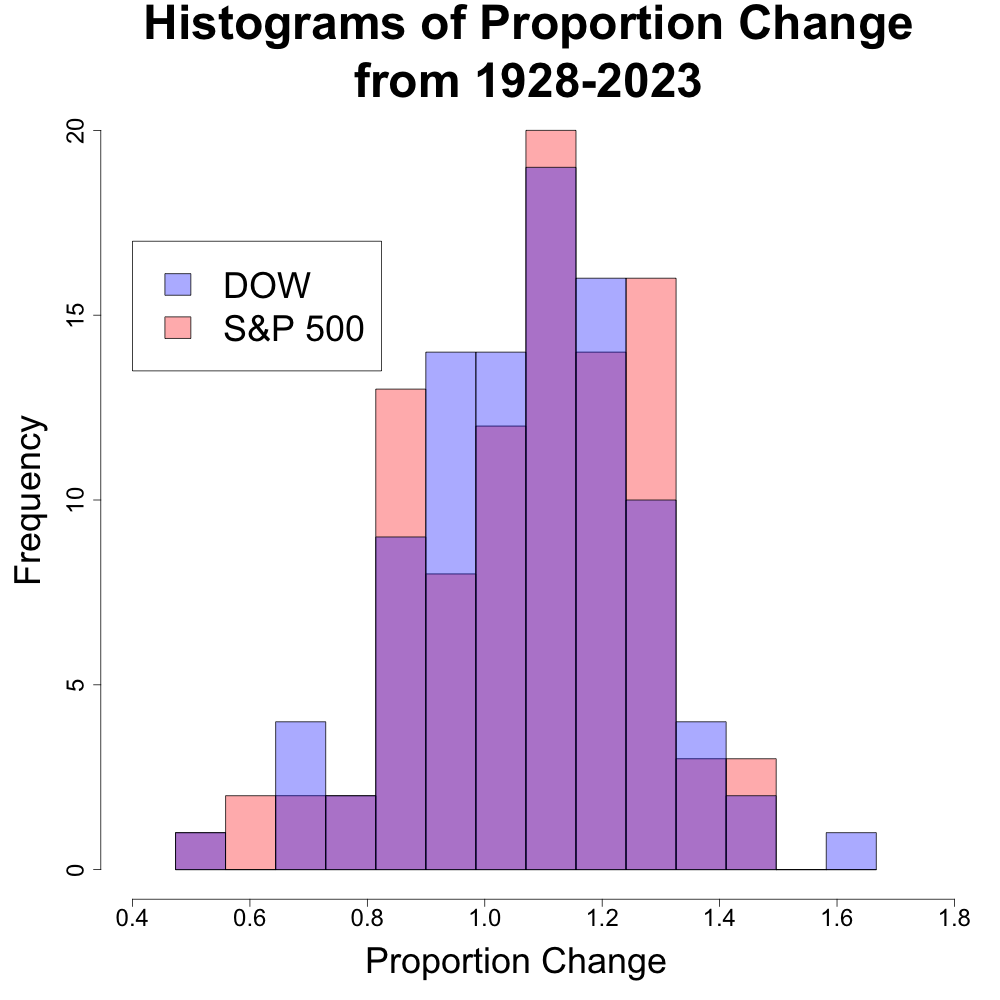
We compared the annualized historical returns of the DJIA and the S&P 500 over the same time period (1928 to 2023). While initial plots suggested the Dow Jones might even outperform the S&P 500, further analysis revealed a different story. The code and output from this analysis is provided at my GitHub link: https://github.com/billyl320/sp500_dow_compare 

The above plot represents the returns as “proportion change”.  Proportion change is defined to be the annualized return change.  For instance, a return of 40% would equate to a proportion change of 1+0.40 = 1.40.  A return of -40% would equate to a proportion change of 1-0.40 = 0.60.  We can see that the histograms of the proportion change is fairly similar.  There is even an (albite very very unlikely) chance that the DJIA may have years of the greatest return due to have the maximum value across both indexes.  

Average Returns Are Similar

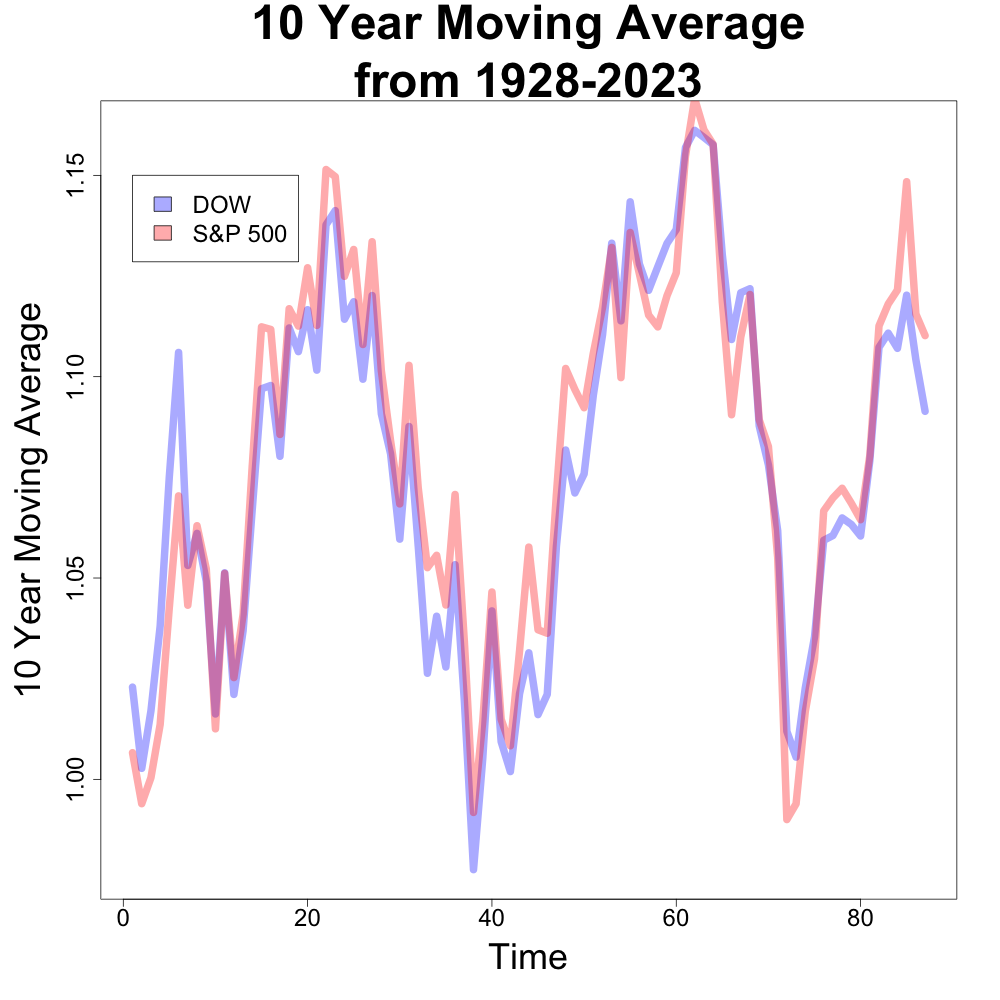
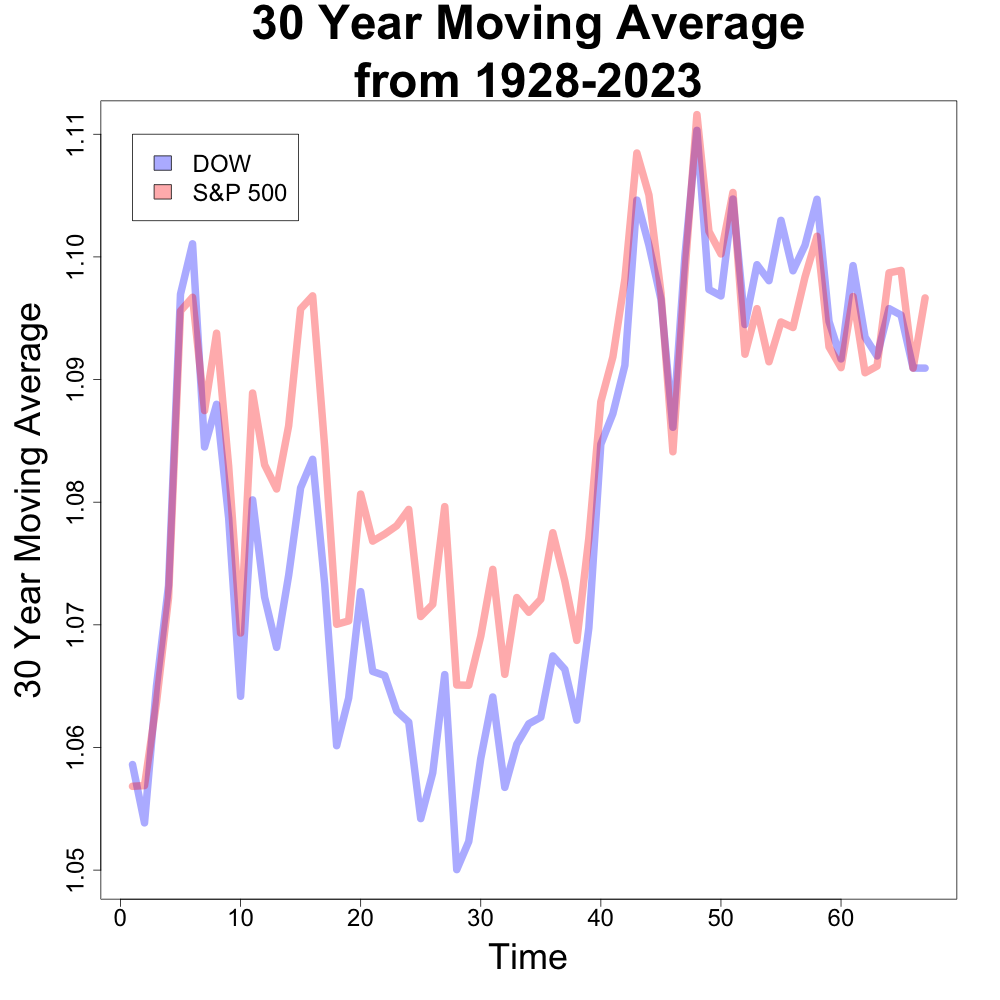
Financial experts often cite similar average returns for both indexes across different time periods [1, 2, 3]. Our analysis confirms this. While both indexes have experienced periods of strong growth and decline, their long-term average returns tend to be close.  Below are the 10 year and 30 year moving averages of both indexes.  (This is especially true in more recent years.)  The x axis is time where the larger values indicate more recent years.  

Median Returns Tell a Different Story

However, looking deeper, we found a larger difference in the medians. Recall that the median represents the “middle” value in a dataset, where half is less than the median and the other half is greater.  The average or mean does not guarantee to have half of the data on either side of it. 

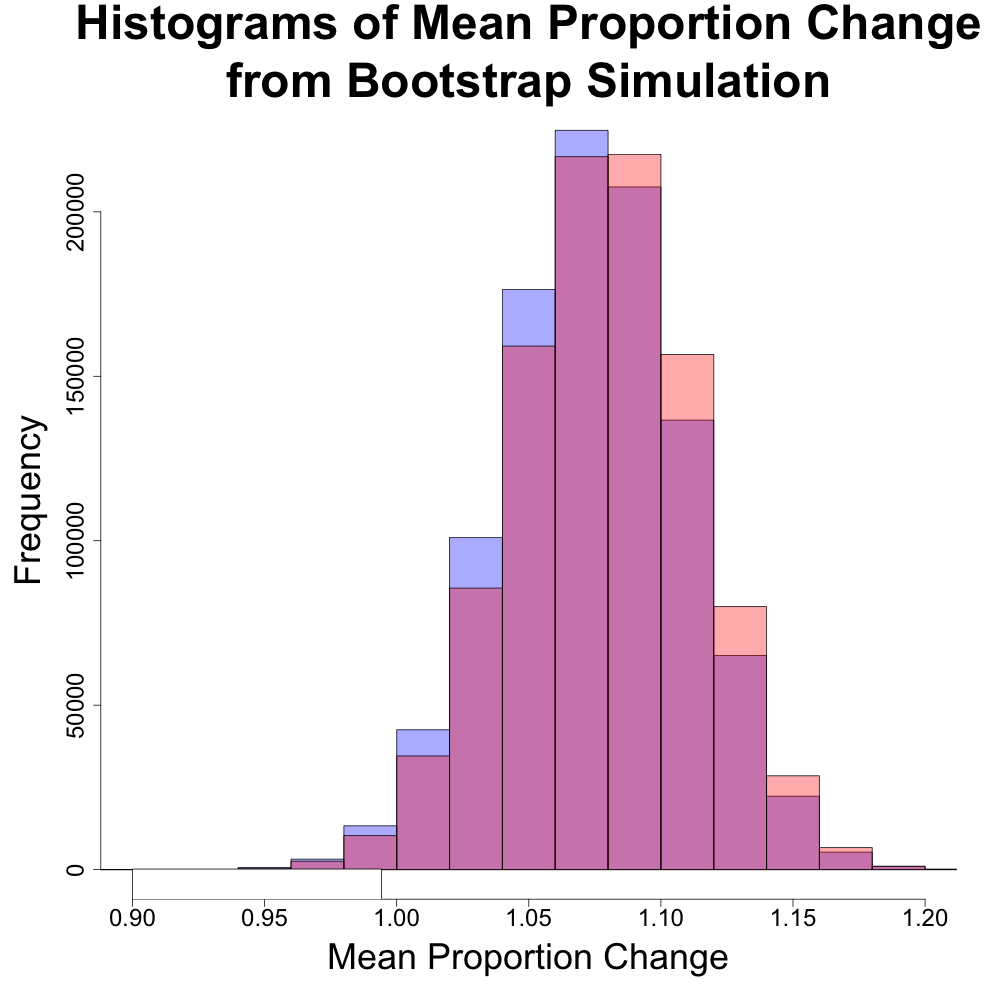
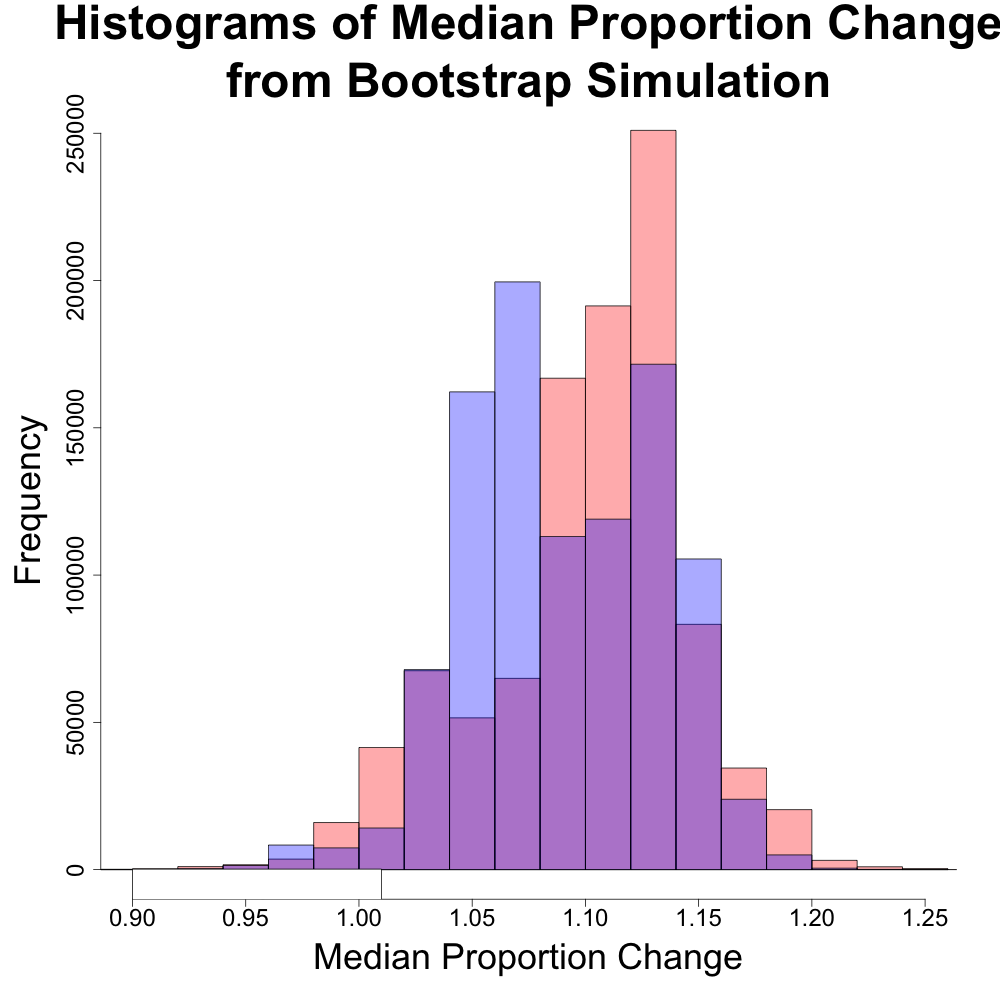
The above histogram compares the distributions of the means of the DJIA and S&P 500 (in blue and red, respectively).  The distributions are very similar and would suggest that either index would give similar rates of performance.  

The above histogram compares the distributions of the medians of the DJIA and S&P 500 (in blue and red, respectively).  The distributions are very different and would suggest that either index behaves differently.  The DJIA has two peaks, one closer to a 5% annualized return and one closer to 15%.  The S&P 500 has one primary peak around a 15% annualized return.  This suggests that it is more likely to have higher returns with the S&P 500 than the DJIA, despite having a similar range for the median.  

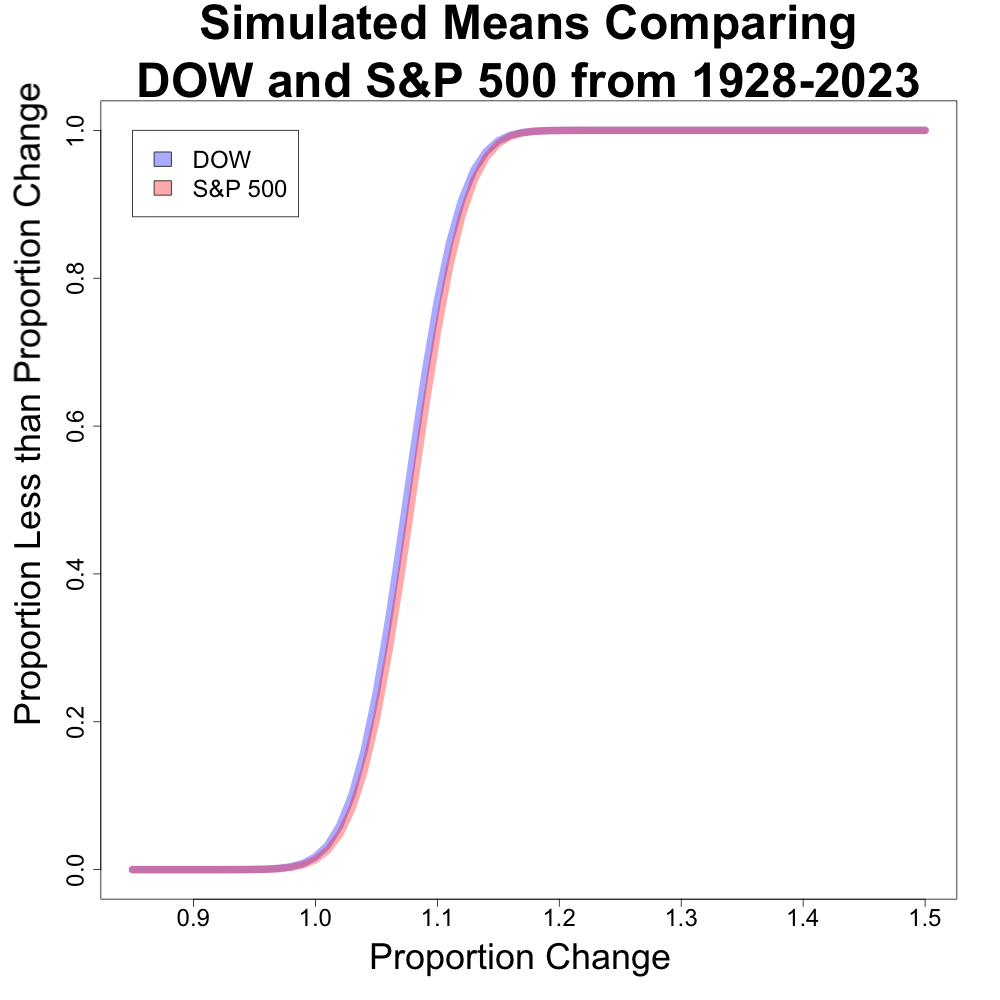
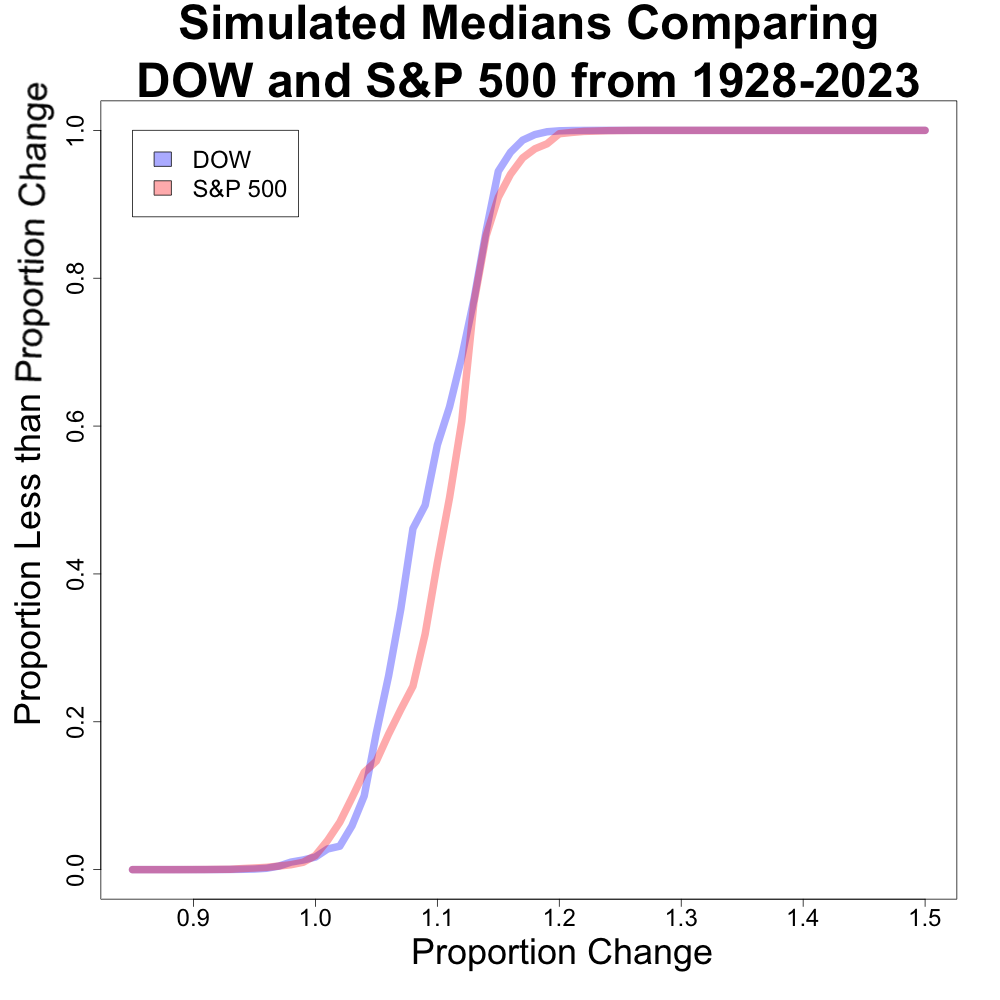
This got me thinking, “Is there a good way to represent how different these distributions are?”.  I created a plot comparing the proportion of medians less than a given value for both of these (this is very similar to an estimated CDF plot).  I first looked at this plot for the means, and then the median.  

The plot for the means are very similar with no noticeable differences in the plot.  Generally speaking, we would expect a better performing index to have a line closer to the x axis for a longer stretch of proportion change.   

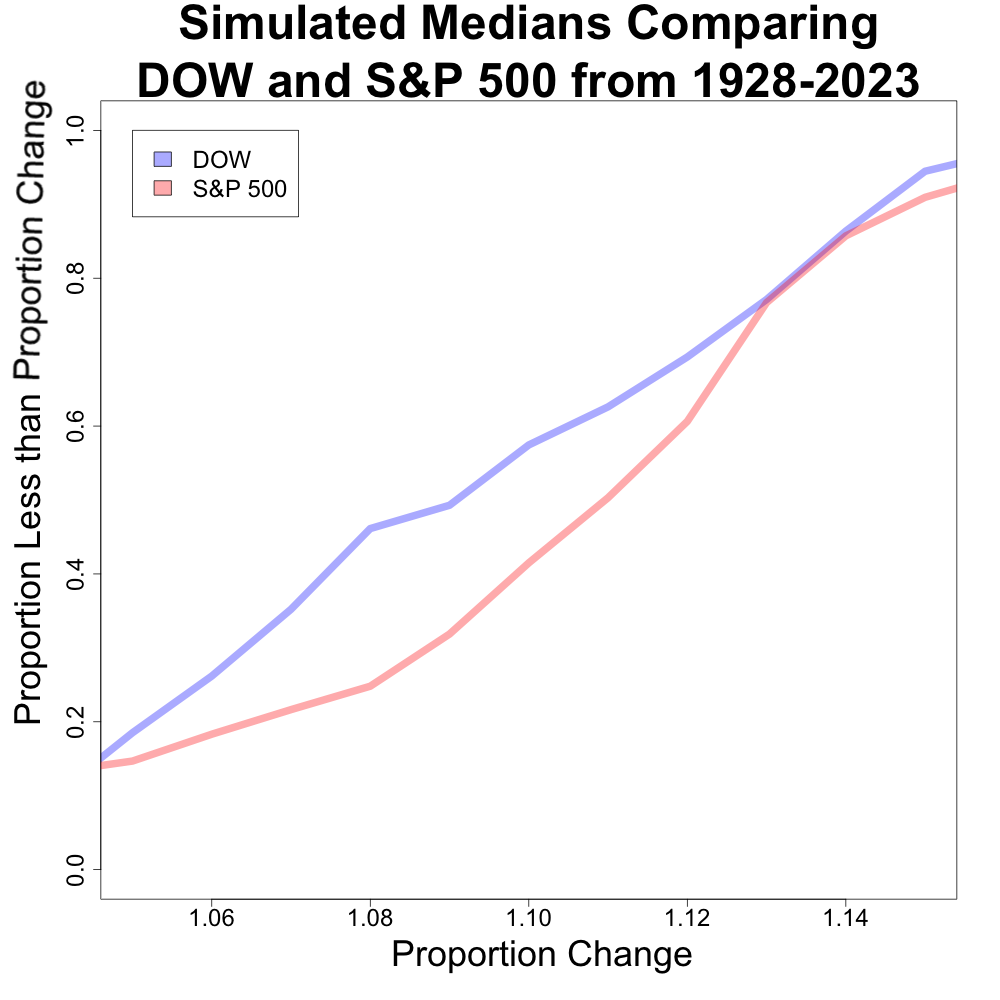
However, when we look at the median counterpoint, we can see some deviations between the x axis values of about 1.06 to 1.14. The next plot looks as a zoomed in section of this part of the plot.  

This plot shows that there is a large discrepancy between the two indexes.  For example, the distribution of the S&P 500 median has less than 20% of its distribution less than 8%.  Conversely, the distribution of the DJIA median has over 40% of its distribution less than 8%.  The distributions begin to converge after 1.14.

So, Which Index is Better?

Based purely on historical data and risk tolerance, the S&P 500 appears to be the better choice. Here’s why:

  • More Consistent Growth: The distribution of the S&P 500’s median return suggests steadier growth potential since it only has one major peak.
  • Greater Diversification: The S&P 500 tracks 500 companies, offering broader diversification compared to the Dow Jones’s 30 companies.

Are There Reasons to Choose the Dow Jones?

While the S&P 500 might be the analytical favorite, there are potential reasons to consider the Dow Jones:

  • Social Investing: An investor might have issues investing in many of the companies in the S&P 500.  Investing in the DJIA might provide a list of less problematic companies for the investor.  
  • Easier for Self Management: It also might be easier to create a self-driven portfolio without using investment products like ETFs using the DJIA than the S&P 500.  
  • Potential for Higher Returns (with Higher Risk): The Dow Jones has experienced some periods of higher returns than the S&P 500 (as due to the one year with outsized returns for the DJIA in the historical data). However, this comes with the risk of larger potential losses.

The Final Word

The “better” index depends on your investment goals. If you prioritize consistent growth and diversification, the S&P 500 might be ideal. However, if you’re comfortable with potentially higher risk for potentially higher rewards, the Dow Jones could be an option.

Is there anything that I didn’t consider that you would have? Anything that you might have done differently? Let me know and perhaps I can do a follow up to this!

Remember: Regardless of which index you choose, consulting with a financial professional is crucial before making any investment decisions. They can help you create a personalized investment plan that aligns with your financial goals and risk tolerance.

3 Essential Python Looms for Unraveling the Data Oracle’s Destiny

For those who dare to plumb the depths of the digital unknown, fear not! Within the Python language lies a trove of libraries, ready to empower your quest for knowledge. Today, we delve into the three of some of the most potent libraries at the data scientist’s disposal: NumPy, Pandas, and scikit-learn.

NumPy, the Swift Elixir

 Imagine swirling numbers into a shimmering vial. This is the magic of NumPy, the master of efficient calculations. Forget clunky lists and for loops! NumPy conjures multi-dimensional arrays, where data is organized in a manner that is efficient for various complex calculations. I personally use NumPy arrays as a format to organize image data in a clean manner. From vectorized calculations to matrix manipulations, NumPy is the fuel that propels your data analyses from a snail’s crawl to a cheetah’s sprint.

Pandas, the Data Sculptor

 But raw data, like unhewn ore, requires refinement. Enter Pandas, the alchemist’s chisel. This library cleanses and shapes your data for many applications, transforming spreadsheets into glistening dataframes. Missing values vanish, inconsistencies smoothen, and columns align like soldiers under a data-driven banner. Indexing, merging, and grouping become much easier, each incantation revealing the hidden structure within your datasets. Pandas is the potter’s wheel, molding data into forms ready for analysis and prediction.

Scikit-Learn, the Seer of Patterns

 Now, with your data polished and primed, you yearn to peek through the veil of the unknown. This is where scikit-learn emerges, a grimoire of potent algorithms, each a key to unlock the secrets hidden within your numbers. Regression, classification, clustering – these are the algorithmic spells available at your disposal. Training algorithms to these data allow the incantor to discern patterns and trends. With each line of code, you imbue these models with the hidden patterns of your data, transforming them into seers that glimpse the future, predict outcomes, and reveal correlations unseen by mortal eyes.

But remember, young alchemists, these elixirs are potent. Like any great power, data analysis demands responsibility. Master the craft, understand the algorithms, and wield these libraries with a steady hand. For within your grasp lies the potential to unravel mysteries, solve problems, and shape the course of the digital future. So, go forth, brew your own data-driven destiny, and remember: the true magic lies not in the libraries themselves, but in the questions you ask and the insights you extract from the swirling storm of information. Now, raise your flask of data, and let the data analysis begin!

Note: Bard was used to help write this article.  Midjourney was used to help create the image(s) presented in this article.

Unlock the Magic: Data Science with R’s Enchanting Elixirs

Forget bubbling demagogues and cryptic chants – the modern data scientist wields R, and their laboratory brims with potent packages. Today, I unveil three essential packages for deriving data-driven insights: e1071, ggplot2, and caret. Brace yourselves, fellow data scientists, for we’re about to transmute raw data into shimmering pure gold!

If you are just starting out with programming, consider looking into my intro to programming textbook using R.  If you prefer a video format, I also have a video series on the topic.

1. Elemental Essence: e1071

Think of e1071 as your alchemist’s cabinet, overflowing with potent algorithmic elixirs. From fiery linear regressions to swirling support vector machines, it offers a dizzying array of tools to unravel the mysteries of your data. Whether you seek to predict customer churn with the precision of a crystal ball or cluster market segments like constellations, e1071 fuels your analytical fire.

If you are interested in getting started modeling with R, I would suggest the Introduction to Statistical Learning with R (ISLR 2nd Edition Affiliate Link, Non-Affiliate Free PDF Link).  If you prefer a video format, I created an intro to machine and statistical learning video series.

2. Crystallize Clarity: ggplot2

Data may whisper its secrets, but ggplot2 amplifies them into dazzling visual tapestries. This package is your potion for transmuting numbers into breathtaking graphs, charts, and maps. With its intuitive incantations and boundless flexibility, ggplot2 isn’t just for eye candy – it’s about weaving narratives from data that captivate both the scientist and your broader audiences.

3. The Crucible of Model Curation: caret

Crafting the perfect machine learning model can be a chaotic art. But fear not, aspiring alchemists – caret will create an orderly way to manage the art. This package orchestrates the entire process, from data cleaning to model training. With caret, you can experiment with algorithms like alchemical ingredients, optimize hyperparameters with practiced precision, and ultimately declare the champion model, ready to unlock the secrets of your data.

So, how do these three reagents form the Data Alchemist’s ultimate elixir?

  • e1071 provides the raw power of algorithmic transmutation.
  • ggplot2 crystallizes insights into mesmerizing visual clarity.
  • caret stirs the cauldron of model creation with masterful efficiency.

Mastering these tools equips you to tackle real-world problems with the wisdom of Merlin himself. Predict stock market fluctuations, optimize resource allocation, or discover hidden patterns in social media – the possibilities are endless.

This is just the first step on our data scientist journey. Stay tuned for deeper dives into each package, secret spells for data wrangling, and thrilling adventures in the uncharted lands of data science. Now, grab your beakers, fire up R, and let’s transform the world with the alchemy of code!

Are there additional topics regarding data science you would like me to cover next? Consider reaching out to let me know what I should talk about next time!

Note: Bard was used to help write this article.  Midjourney was used to help create the image(s) presented in this article.

Essential Skills for Mastering the Arcane Art of Data Science in 2024

The US Bureau of Labor Statistics has pointed out the strong demand for skilled data scientists.  In my opinion, this is more crucial than ever as companies across industries are scrambling to harness the power of artificial intelligence (AI). But this isn’t just about weaving spells with algorithms; it’s about building bridges between raw data and people to make impactful results.

So, aspiring data wizards, what ingredients do you need to brew the perfect career potion in 2024? Let’s break down the essential skills you’ll need to master for 2024 and beyond!

1. Coding Alchemy: Python, R, and the SQL Elixir:

Think of programming languages as your incantations. Python, R, and SQL are the most potent brews in the data scientist’s cauldron. Python is very powerful for its versatility and vast libraries like NumPy and Pandas. R, meanwhile, is the go-to for statisticians with its focus on statistical modeling and analysis. And don’t forget SQL, the language that unlocks the secrets hidden within databases. Mastering these languages isn’t just about writing code; it’s about understanding the logic and structure behind them, allowing you to wield them with precision and efficiency to complete tasks ranging from the mundane to the arcane.

If you are just starting out with programming, consider looking into my intro to programming textbook using R.  If you prefer a video format, I also have a video series on the topic.

2. From Raw Data to Refined Insights: Modeling the Future:

Data is the raw material, but the real magic lies in transforming it into actionable insights. This is where your analytical skills come into play. You need to be able to clean, wrangle, and explore data, identifying patterns and trends that might otherwise be illusive. Statistical modeling and machine learning algorithms are your tools for building predictive models, uncovering hidden relationships, and ultimately, understanding what the data is capturing in the world around us.

If you are interested in getting started modeling with R, I would suggest the Introduction to Statistical Learning with R (ISLR 2nd Edition Affiliate Link, Free PDF Link).  If you prefer a video format, I created an intro to machine and statistical learning video series.  The Python version of the textbook is also available (ISLP Affiliate Link, Free PDF Link). 

3. Bridging the Gap: From Geek to Guru:

Remember, data science isn’t just about interacting with machines; it’s about speaking to people. Your ability to translate complex findings into clear, concise, and compelling stories is crucial. Think of yourself as an interpreter, guiding stakeholders (such as team members, managers, or those whom you serve) through the labyrinth of data to actionable insights. Strong communication skills, both written and verbal, are essential for building trust and ensuring your work has a real-world impact.

4. The Unspoken Secrets: Soft Skills Make You a Sorcerer Supreme:

Beyond the technical wizardry, there are unspoken skills that make you a truly exceptional data scientist. Collaboration and teamwork are paramount, as you’ll often be working with engineers, analysts, and business leaders.  Further, being able to fit into the team culture is a critical component for enjoying your job.  So this isn’t something you can simply ignore and hope will work itself out.  

Remember, data science isn’t just about crunching numbers; it’s about applying creativity, critical thinking, and a collaborative spirit to solve real-world problems. So, hone your coding skills, refine your analytical abilities, and unlock the power of communication. With the right ingredients in your cauldron, you’ll be well on your way to becoming a data science sorcerer supreme in 2024 and beyond!

Are there additional topics regarding data science you would like me to cover next? Consider reaching out to let me know what I should talk about next time!

Note: Bard was used to help write this article.  Midjourney was used to help create the images presented in this article.